

Building your dream home on a Texas Hill Country property is exciting, until you discover that running power to your house pad costs more than your truck, or that the rocky ground won’t support a conventional septic system. Unlike building in a city subdivision where utilities wait at the curb, rural Hill Country land demands that you plan, budget, and install every essential service yourself.
The good news? With proper research and the right team, you can create a home with reliable electricity, clean water, and modern communications that rivals anything in Austin’s walk-able downtown. This guide walks you through the complete process of planning utilities for your Hill Country home, from initial site evaluation through final inspections.
Start Here: A Quick Utility Planning Checklist for Hill Country Homes
Utility mistakes on rocky Hill Country terrain can be expensive and often impossible to fix after construction. A septic field in the wrong spot can’t be moved. Power lines buried without proper conduit can’t easily accommodate future needs. The time to get this right is before you finalize your house plans—or even before you close on the land.
Before any utility work begins, thorough site prep for Hill Country homes ensures proper grading, access routes, and trench layout. This preparation helps prevent costly rework once construction starts.
Use this checklist before committing to your property or house placement:
- Confirm electricity options: Contact the local utility company (common examples include Pedernales Electric, Bluebonnet, or Bandera Electric) to determine distance to existing power lines and extension costs
- Confirm water source: Verify whether municipal water reaches the property, or plan for a private well or rainwater system with appropriate permits
- Choose wastewater solution: Order a soil and site evaluation to determine septic system requirements
- Plan for gas or propane: Check natural gas availability; typically unavailable, plan propane tank placement and line routes or go all electric
- Verify internet and cell coverage: Test actual signal strength on-site and research fixed wireless, fiber, or satellite options
- Budget with contingencies: Add 15-20% to initial utility estimates for rocky ground surprises
- Gather permits early: Contact county offices about OSSF permits, driveway permits, and well registration requirements
In many Central Texas counties—Hays, Comal, Blanco, Gillespie, and Kendall among them—utility feasibility should be completed before closing on vacant land, or at minimum before finalizing architectural plans. Rock, slope, and distance to county roads dramatically affect trenching and connection costs in ways that don’t apply to flat suburban lots.
The sections that follow cover each utility system in detail, tailored specifically to Hill Country conditions and regulations.
Understanding Your Hill Country Site
The Texas Hill Country’s limestone geology, karst formations, and rolling topography make utility planning fundamentally different from flat suburban lots. What works in a Houston subdivision often fails here, or costs three times as much to make work.
Before designing any utility system, you need to understand your specific piece of ground.
If you are still evaluating potential tracts, our team can help you find buildable land with utilities nearby. Choosing land with easier utility access can save time and money during construction.
Evaluating Terrain and Access
- Map elevation changes between the planned house pad and the county road or utility easement. A property that rises 200 feet over a quarter-mile driveway will require significant pump capacity for water and may need step-down transformers for power.
- Identify slopes and draws that affect where utilities can run. Low areas may flood seasonally, making them poor routes for buried lines.
- Check rock depth through soil reports, test pits, or prior drilling records in the area. Shallow limestone—often just 2-10 feet down—dramatically increases trenching costs for electric, water, and septic lines.
Understanding Legal Boundaries and Easements
- Review the recorded plat or deed for existing easements, utility corridors, and right-of-way access. Some rural property in Travis County’s ETJ has different requirements than unincorporated Llano County land.
- Verify property boundaries before planning any infrastructure. Utility easements often follow fence lines that don’t match legal boundaries.
- Check for existing infrastructure like abandoned wells, old septic systems, or buried propane tanks that could affect new installations.
Walking the Land
Walk your property in both wet and dry conditions. Look for:
- Low areas, seeps, and seasonal creeks that limit septic placement
- Existing vegetation that indicates water availability or drainage patterns
- Access routes for drilling rigs and delivery trucks
- Southern exposure for potential solar installations
Example: A 10-acre tract in western Travis County with 200 feet of elevation change between the road and the building site can easily double pump and trenching costs compared to a flat parcel, adding $30,000-$50,000 to utility infrastructure before the house is even framed.
Planning Power: Grid, Solar, or Hybrid for Hill Country Homes
The Hill Country offers abundant sunshine and increasingly affordable solar technology, while traditional co-op power provides reliability—at a price. Your power decision affects not just move-in day, but 20-30 years of living in your new home.
Estimating Your Power Needs
Before contacting the power company or sizing a solar system, estimate how much electricity your household will actually use:
| Home Type | Typical Annual Usage | Key Loads |
| Weekend cabin (1,500 sq ft) | 5,000-8,000 kWh | Basic HVAC, well pump, lighting |
| Full-time home (2,000-3,000 sq ft) | 12,000-18,000 kWh | HVAC, well pump, appliances, home office |
| Large home with shop | 20,000-30,000+ kWh | Multiple HVAC zones, shop equipment, EV charging |
Don’t forget to plan for future demand: EV charging, a detached shop, or a guest casita can add significant load. It’s far cheaper to install capacity now than to upgrade later.
Comparing Your Options
Grid-tied (co-op power only)
- Reliable for daily use, but rural outages can last 2-3 days after storms
- Monthly bills vary by usage, typically $0.10-0.14/kWh
- Connection costs depend heavily on distance to existing infrastructure
Fully off-grid (solar + batteries)
- Complete energy independence with zero monthly bills
- Requires significant battery storage for cloudy stretches and winter demand
- Higher upfront cost ($60,000-$120,000+ for a full system)
Hybrid (grid + solar + batteries)
- Most popular choice for Hill Country homeowners
- Provides resilience during ERCOT grid events while reducing monthly costs
- Solar can offset 70-100% of annual usage with proper sizing
All electrical work must follow the National Electrical Code (NEC) and your co-op’s specific requirements. Permanent installations require licensed electricians and final inspection before energizing.
Distance and Cost: Reaching the Grid in the Hill Country
The single biggest cost factor for rural Hill Country power is distance to the nearest transformer or overhead power lines. A home 200 feet from the road pays a fraction of what a home 2,000 feet up a rocky hillside pays.
Typical Line Extension Costs in Hill Country Terrain
| Extension Type | Cost Per Foot | Notes |
| Overhead lines | $20-50 | Cheaper but prone to storm outages; poles may require rock anchoring |
| Underground lines | $50-100+ | More reliable; costs escalate quickly in solid limestone |
A 1,500-foot run from the road to your house can easily reach $50,000-$100,000 for underground installation in rocky ground—sometimes making a well-designed solar system the more cost effective option.
Co-op Policies to Investigate
- Pedernales Electric Cooperative and similar co-ops often provide a certain number of feet of line extension at reduced or no cost (sometimes 500-1,000 feet)
- Get these policies in writing before budgeting
- Ask about load-based credits if you’re building a larger home with high demand
The Basic Connection Process
- Submit application with preliminary site plans
- Provide load calculation based on house size and planned equipment
- Co-op conducts site visit to assess route and challenges
- Negotiate easement paperwork if lines cross other properties
- Pay for extension and wait for installation (typically 4-8+ weeks)
Solar and Battery Options for Hill Country Properties
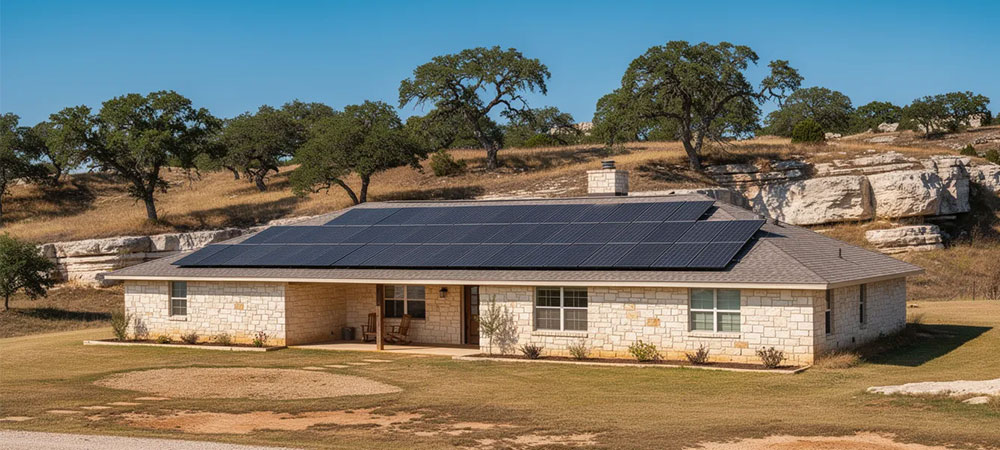
The Hill Country receives 220+ sunny days annually, making solar panels an excellent investment. Combined with battery storage, solar provides resilience during the grid outages that affect rural areas 2-5 times more often than urban Austin.
Mounting Options
- Roof-mounted: Most cost effective if your roof has good southern exposure and adequate space without heavy shading from cedar or oak trees
- Ground-mounted: Better for heavily wooded sites or complex roof lines; allows optimal orientation regardless of house design
Sizing for Hill Country Homes
A typical 2,000-2,500 sq ft home with a well pump and aerobic septic blower needs:
- 10-15 kW solar array to offset 80-100% of annual usage
- 13-30 kWh battery storage for 2-3 days of cloudy weather backup
- Backup generator connection for extended winter storms
Off-Grid vs. Grid-Tied with Backup
| Feature | Fully Off-Grid | Grid-Tied Hybrid |
| Monthly utility bill | $0 | $20-80 (grid charges + net usage) |
| Upfront cost | Higher (larger battery bank) | Moderate |
| Reliability | Depends entirely on system design | Grid backup for cloudy periods |
| ERCOT event protection | Complete independence | Battery provides 1-3 days backup |
Federal tax credits currently offset 30% of solar and battery installation costs through 2032. Combined with the high reliability value in rural areas, many homeowners see payback windows of 7-12 years. Consult a tax professional for guidance on your specific situation.
Water: Wells, Rainwater, and Community Systems
Most rural Hill Country tracts outside city limits have no access to municipal water. Your options are a private well, rainwater harvesting, or membership in a small water supply corporation—each with distinct costs, regulations, and reliability characteristics.
Determining Your Water Source Options
Start by verifying what’s actually available:
- Check with local water supply corporations or special utility districts. Some rural areas have small community systems with limited capacity.
- Research municipal water boundaries if you’re near city limits. Austin Water and San Antonio Water System serve specific areas that may or may not include your property.
- Plan for a private well if no public water is available—the default for most Hill Country acreage.
Well Drilling in Hill Country Geology
Private wells in the Hill Country tap the Trinity or Edwards aquifers through fractured limestone. Conditions vary dramatically across short distances.
| Factor | Typical Range | Impact on Cost |
| Well depth | 200-800 feet | Deeper = higher drilling cost |
| Yield | 5-20 GPM | Lower yields may need storage tanks |
| Drilling cost | $5,000-$30,000+ | Varies by depth, geology, and access |
| Pump and equipment | $3,000-$8,000 | Submersible pumps rated 1-5 HP |
| Water treatment | $2,000-$10,000 | Often needed for hardness, iron, bacteria |
Critical step: Contact the relevant Groundwater Conservation District before drilling. Examples include:
- Hays Trinity Groundwater Conservation District
- Barton Springs/Edwards Aquifer Conservation District
- Cow Creek Groundwater Conservation District
These agencies impose well spacing requirements (typically 50-100 feet from property lines), production limits, and registration fees around $200-500. They also maintain drilling logs from nearby wells that can indicate expected depths and yields.
Dry holes occur in 10-20% of drilling attempts in low-permeability zones. Hiring a hydrogeologist for fracture trace analysis before drilling can significantly improve success rates.
Rainwater Harvesting as Primary or Backup Supply
Rainwater collection is increasingly popular—and sometimes required by HOA covenants in Hill Country communities. For a full-time home:
- Roof catchment area: 2,500 sq ft roof yields roughly 1,500 gallons per inch of rain
- Storage capacity: 20,000-40,000+ gallons for year-round primary supply
- System cost: $15,000-$40,000 installed for a complete potable water system
- TCEQ standards: Must include filtration and disinfection for drinking water
Rainwater works well as a backup to wells or for irrigation, reducing groundwater demand by 30-50%.
Don’t forget: Plan power for well pumps (including high start-up loads) and frost protection for tanks and lines. A frozen pressure tank can leave you without water for days.
Well Siting and Protection
Where you place a well matters for both yield and long-term water quality—especially in karst terrain where surface contamination can reach groundwater quickly through sinkholes and fractures.
Setback Requirements
- From septic systems: 100-200 feet minimum (varies by county and system type)
- From property lines: 50-100 feet per GCD rules
- From livestock areas: 100+ feet recommended
- From fuel storage: 150+ feet
Access and Maintenance Considerations
- Choose a site accessible to drilling rigs (often 30-40 feet tall) and future service trucks
- On steep or heavily wooded properties, well access may dictate driveway routing
- Plan for permanent access even after landscaping is complete
Wellhead Protection
- Seal the wellhead properly with a sanitary cap
- Grade the area for drainage away from the well
- Keep chemicals, pesticides, and fuel storage at least 150 feet away
- Install a lockable well house in areas with vandalism risk
Example: A well drilled down-slope from a barn in Kendall County tested positive for coliform bacteria within two years. The homeowner faced $8,000 in remediation costs plus ongoing UV treatment—expenses that proper initial siting would have avoided.
Wastewater: Septic and Alternatives in Rocky Ground

Most Hill Country homes outside city limits use on-site sewage facilities (OSSFs), commonly called septic systems. The region’s shallow soils over limestone often require specialized—and more expensive—treatment systems.
Understanding System Types
Your soil conditions determine which septic system types the county will permit:
| System Type | Typical Cost | Best For | Maintenance Level |
| Conventional (gravity) | $7,000-$12,000 | Deep, permeable soils | Low (pump every 3-5 years) |
| Low-pressure dosing | $12,000-$18,000 | Moderate soils with adequate depth | Moderate |
| Aerobic treatment unit | $15,000-$25,000+ | Shallow soils, near water features | High (quarterly inspections, chlorine) |
| Drip dispersal | $20,000-$30,000+ | Rocky soils, limited area | High |
A professional soil and site evaluation ($500-$1,500) is mandatory before designing any system. The evaluator probes for bedrock depth and clay layers—in the Hill Country, 40-60% of sites require alternatives to conventional septic.
Case study: A 10-acre Blanco County tract with rocky soils required a drip dispersal system costing $25,000, compared to $10,000 for a conventional system on a nearby parcel with deeper loam soils.
Permits and Oversight
All septic installations require permits from your county’s OSSF department, operating under TCEQ regulations. The process typically includes:
- Soil and site evaluation by licensed professional
- System design by licensed installer or engineer
- Permit application with county health department
- Installation with inspection at multiple stages
- Final inspection before backfilling
For aerobic systems, ongoing requirements include maintenance contracts with regular inspections, typically every 4-6 months at $150-$300 per visit.
Locating Septic Relative to Your Home and Utilities
Septic placement often determines—or limits—where your house, driveway, and outdoor living spaces can go. Get this wrong, and you may find your preferred building site won’t work.
Required Separation Distances (Texas Rules)
| Feature | Minimum Distance from Septic |
| Private water well | 100-200 feet (varies by system type) |
| Property line | 10-25 feet |
| Structure foundation | 10 feet |
| Swimming pool | 25 feet |
| Creek or drainage | 50-100 feet |
These distances must be measured from both the septic tank and the drain field or dispersal area.
Protecting the System Area
- Mark septic and drain field locations before any site clearing
- Keep heavy equipment off drain field areas permanently
- Plan driveways and future outbuildings to avoid the system footprint
- On smaller tracts (5 acres or less), septic placement may constrain house orientation significantly
Coordinating Trenching
On solid limestone sites, every trench is expensive. Plan septic lines and electrical conduits to avoid competing for the same routes—or consolidate utility corridors where codes permit.
Gas, Propane, and Heating Strategies
Natural gas lines rarely extend into rural Hill Country areas, leaving homeowners to choose between all-electric homes and propane systems for cooking, heating, water heating, and backup generator fuel.
Checking Natural Gas Availability
Before assuming you’ll need propane:
- Contact local utilities serving your area (Texas Gas Service, CenterPoint, or city-specific providers)
- Check with neighbors—lines sometimes run along county roads even in rural areas
- Review city utility maps if you’re in or near an incorporated area like Fredericksburg or Kerrville
For most Hill Country properties more than a mile from town, propane is the practical choice.
Propane System Planning
Tank Options
| Tank Size | Typical Use | Placement | Approximate Cost |
| 250 gallons | Cooking, water heater, fireplace | Above-ground | $1,500-$2,500 |
| 500 gallons | Cooking, water heater, heat | Either | $2,500-$4,000 |
| 1,000 gallons | Whole-house heating, cooking, generator | Buried preferred | $4,000-$6,000 |
Placement Considerations
- Maintain required setbacks from structures, property lines, and ignition sources
- Plan for delivery truck access (tanks need refilling 2-6 times per year)
- Coordinate tank location with outdoor living spaces—you don’t want a tank next to your patio
- Route underground lines to avoid conflicts with future pool or landscaping excavation
The All-Electric Alternative
Modern heat pumps work efficiently in the Hill Country’s mild climate (rarely below 20°F for extended periods), and induction cooking rivals gas performance. An all-electric home paired with solar and battery storage can eliminate fuel deliveries entirely while maintaining comfort and safety.
Internet, Communications, and Smart Home Infrastructure
Internet access has become a fourth utility for Hill Country homeowners—essential for remote work, streaming, security systems, and property monitoring. Planning this infrastructure while walls are open saves significant cost and frustration.
Checking Service Availability
Before closing on land, verify actual internet options:
- Fiber/cable: Available near I-35 corridor from providers like GVEC (up to 1 Gbps); rare in rural areas
- Fixed wireless: Common in Hill Country (50-100 Mbps typical); requires line-of-sight to tower
- Satellite: Available everywhere; low-earth-orbit services like Starlink offer 100-300 Mbps at $120/month
Check availability by address or GPS coordinates, not just by ZIP code. A property 5 miles from town may have completely different options than one 2 miles away.
Pre-Wiring for Future-Proofing
Even if running fiber on day one isn’t possible:
- Install conduits from the road to the house during driveway construction
- Run low-voltage wiring (Cat6 or better) to each room while walls are open
- Designate a network closet or cabinet for equipment with adequate power and ventilation
- Plan outdoor conduit runs for future cameras, gate controls, and landscape lighting
Connected Property Systems
Beyond streaming and email, consider infrastructure for:
- Automatic gate openers with camera intercoms
- Driveway sensors and security cameras
- Well pump monitoring and low-water alerts
- Septic system alarms and aerator status
- Whole-house generator controls and battery system monitoring
These systems need power, network connectivity, and often cellular backup—plan for them early.
Cell Service and Emergency Communications
Rural Hill Country properties often have limited cell coverage and long emergency response times. Reliable communication isn’t just convenient—it’s a safety issue.
Verify Actual Coverage
- Walk the property with phones from multiple carriers (AT&T, Verizon, T-Mobile)
- Test at the proposed house pad, driveway entrance, and any low spots
- Check signal at different times of day—networks can be congested during peak hours
Improving Weak Signal
- Cell boosters: Amplify existing signal inside the home ($500-$1,500 installed)
- External antennas: Roof-mounted antennas with interior repeaters for weak areas
- Wi-Fi calling: Uses internet connection for calls when cell signal is inadequate
Backup Communication Options
- Internet-based landlines (VoIP) provide a backup if cell service fails
- Satellite messaging devices for true emergencies in dead zones
- Contact your local volunteer fire department about their communication recommendations for your area
Integrate these considerations into your overall electrical and low-voltage plan rather than treating them as an afterthought.
Budgeting, Permits, and Building Your Utility Team
Utility costs in the Hill Country regularly exceed expectations, especially for properties with long driveways, steep terrain, or shallow rock. Early budgeting—with realistic contingencies—prevents the painful surprises that delay occupancy and bust budgets.
Realistic Cost Ranges for Hill Country Utilities
| Utility System | Budget Range | Key Variables |
| Electric extension | $5,000-$100,000+ | Distance, underground vs overhead, rock |
| Solar + battery hybrid | $40,000-$80,000 | System size, battery capacity |
| Well drilling + equipment | $10,000-$40,000 | Depth, yield, water treatment needs |
| Rainwater system (potable) | $15,000-$40,000 | Tank size, filtration level |
| Septic system | $8,000-$30,000 | Soil conditions, system type required |
| Propane tank + lines | $3,000-$8,000 | Tank size, line length, rock trenching |
| Internet installation | $500-$5,000 | Service type, distance from road |
Total utility infrastructure on a remote site can reach $50,000-$200,000 before any house construction begins.
Sequencing Your Contacts
Make informed decisions by contacting utilities and professionals in this order:
- Electric co-op: Get line extension quote before finalizing house location
- Well driller or water district: Confirm water availability and likely costs
- Septic designer: Order soil evaluation early—results affect house placement
- County offices: Understand permit requirements, fees, and timelines
- Builder/architect: Share utility constraints before finalizing plans
Permits and Approvals Checklist
- County OSSF (septic) permit
- Driveway and culvert permit from county road department
- Well registration with Groundwater Conservation District
- Utility easements (if lines cross other properties)
- Electrical inspection from co-op before final connection
- Rainwater system permits (if used for potable supply)
Assembling Your Team
The Hill Country demands professionals who understand local geology and regulations. Your team should include:
- Builder: Experienced with rural construction and utility coordination
- Civil engineer or site designer: For drainage, septic, and driveway planning
- Licensed septic professional: For evaluation, design, and installation
- Well driller: With experience in your specific aquifer and county
- Electrician: Licensed and familiar with your co-op’s requirements
- Architect (if applicable): Who understands rural utility constraints
River Hills Homes provides complete Hill Country custom home building services. Our team coordinates land evaluation, permitting, and utility planning to create a smooth build process from the start.
Phasing and Future-Proofing Your Utilities

Design your utilities not just for move-in day, but for the next 10-20 years of additions and changes. Modest planning now avoids major rework later.
Oversizing for Future Needs
- Install larger conduits than currently needed—adding a second conduit later through solid rock costs 10x more than running it initially
- Size electrical panels with 25-30% spare breaker capacity for future additions
- Design septic systems with potential guest house or ADU capacity in mind
- Specify well pump and pressure tank capacity for future irrigation or livestock
Documenting What’s Buried
- Photograph all trenches before backfilling, with measurements to permanent landmarks
- Create a site utility map showing buried lines, tanks, and access points
- Save this documentation with your property records—future owners and contractors will need it
Planning Utility Corridors
Route utilities along driveway or fence lines where possible:
- Creates predictable paths for future additions
- Simplifies maintenance access
- Reduces the number of excavation zones across your property
Example: A homeowner in Dripping Springs ran extra conduit and a larger electrical feed to the property corner during initial construction—a $1,200 decision. Three years later, when they added a detached garage and workshop, the infrastructure was already in place. Neighbors who hadn’t planned ahead spent $18,000 trenching through rock for the same addition.
Key Takeaways
- Verify utility feasibility before closing on land or finalizing house placement
- Distance to existing infrastructure—power lines, water mains, paved roads—often determines total utility cost more than the systems themselves
- The Hill Country’s limestone geology requires specialized septic solutions in 40-60% of cases
- Solar + battery systems have become cost effective alternatives to expensive grid extensions
- Budget 15-20% contingency for rocky ground surprises
- Assemble a team experienced with rural Hill Country conditions—not just any licensed professional
Next Steps
Planning utilities for your Hill Country home demands research, coordination, and the right team, but the payoff is decades of reliable and efficient living on your own piece of Texas. It starts with a thorough site evaluation, early conversations with your electric co op and local government offices, and working with professionals who understand the unique challenges of Hill Country construction. A knowledgeable builder can help bring those moving pieces together by coordinating with engineers, utility providers, and site prep crews so critical decisions are made before construction begins.
Your dream home in the open space of the Texas Hill Country is absolutely achievable. With the right planning and a team that knows what to look for beneath the surface, River Hills Homes helps homeowners navigate early utility decisions with clarity and confidence, avoiding costly surprises and setting the foundation for a smooth build from day one.
Before you begin, our budget and cost analysis services can help you plan realistic utility and construction costs for your Hill Country home.