
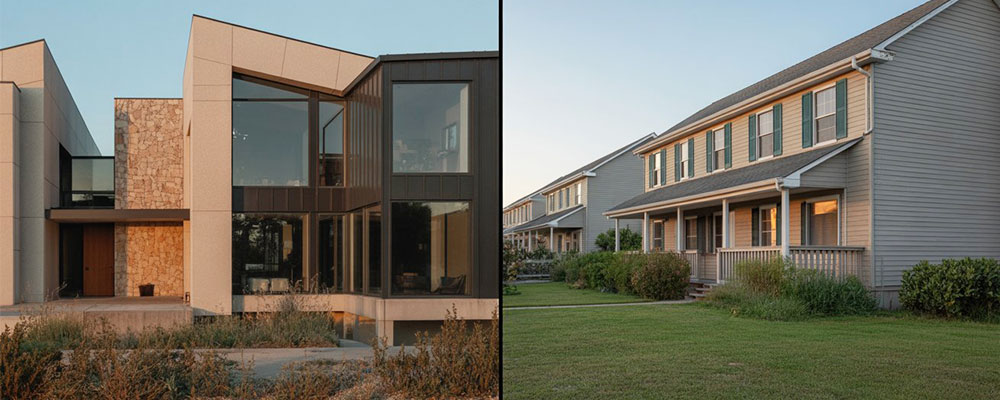
If you’re in the market for a new home in the New Braunfels area, you’ve probably encountered two very different paths: buying a tract home in a production builder’s subdivision, or building a custom home on your own lot. On the surface, the choice often comes down to price. But the real differences go much deeper than the sticker number, and in the Texas Hill Country specifically, what you’re actually buying (or building) looks quite different depending on which path you take.
Here’s a practical breakdown of how the two compare so you can decide which option fits your situation.
What Is a Tract Home?
A tract home, sometimes called a production home, is built by a large-scale developer on land they’ve subdivided into a planned community. The builder offers a small number of pre-designed floor plans, often with limited customization options like cabinet styles, countertop materials, or flooring upgrades. The homes are constructed in batches using standardized materials and bulk purchasing, which keeps costs lower and construction timelines shorter.
Tract home communities are typically master-planned subdivisions with cohesive streetscapes, shared amenities, and HOA governance. The finished product is move-in ready, predictable, and often comes with builder financing and warranties. For buyers who want a new home without the complexity of a custom build, it’s a straightforward path.
What Is a Custom Home?
A custom home is built from the ground up to your specifications, on a lot you choose (or already own). You work with an architect or designer to create a floor plan that doesn’t exist anywhere else, select every material and finish, and make decisions about structural elements, systems, and site orientation. Your builder coordinates the construction and guides you through the process.
Custom home builders are typically smaller, regional companies with deep experience in a specific area. Unlike production builders who work from a catalog, custom builders work from your vision. That means more flexibility, more involvement, and usually a longer timeline.
How They Compare
Here’s how the two options stack up across the factors that matter most when making this decision.
Cost
Tract homes usually win on upfront price. Because production builders buy materials in bulk, use standardized plans, and benefit from economies of scale, they can offer a finished home at a lower price per square foot than a custom build.
Custom homes cost more per square foot because every home is unique. Your costs include architectural design, engineering, individual permitting, and construction management on a project that has no economies of scale. However, custom homes also give you more control over where the money goes. You can prioritize the features that matter most to you and skip the ones that don’t, which isn’t an option in a tract home where the package is set by the builder.
If you already own your lot, the math changes. A custom build on land you own can sometimes be comparable in total cost to buying a tract home, especially when you factor in lot premiums that production builders charge in desirable areas.
Customization
This one isn’t close. Custom homes offer full customization from foundation to finishes. Floor plan, square footage, ceiling heights, window placement, room layout, exterior materials, and every interior detail are decisions you make. If you want a specific layout for aging in place, a home office that fits a particular piece of furniture, or a kitchen designed around how you actually cook, a custom home delivers that.
Tract homes offer customization within the builder’s predefined options. You might be able to pick Floor Plan A, B, or C, choose between a few cabinet styles, and upgrade to quartz countertops for an added fee. Beyond that, the house is what it is. Structural changes, non-standard layouts, or custom millwork aren’t options.
Timeline
Tract homes are faster. Because the builder uses repeatable plans and an assembly-line construction process, a tract home can go from contract to move-in in 4-8 months. Some inventory homes are ready immediately.
Custom homes take longer, typically 10-14 months from design to move-in, sometimes more for complex builds. The design phase alone can take 2-4 months before construction even starts. If you need to be in a home quickly, a tract home has the edge. If you’re willing to wait for something that’s exactly yours, the timeline difference is part of the tradeoff.
Lot Choice and Location
This is where the Hill Country changes the conversation. Production builders work in subdivisions they’ve already platted, which limits your location to places where they’re currently developing. If you want to live on five acres with a view, on a specific street, or in a community where you choose your own builder, a tract home isn’t an option.
Custom homes let you build anywhere you can legally build, including the flexibility to build on your own lot. You can purchase a lot in Vintage Oaks, Cordillera Ranch, Mystic Shores, or any other Hill Country community that allows owner-selected builders, and design a home specifically for that lot’s terrain, views, and orientation. For many people in this market, the lot is the whole reason they’re going custom in the first place.
Quality and Long-Term Value
Quality varies by builder in both categories, but there are some general patterns. Production builders are optimizing for efficiency and cost, which means they tend to use standardized materials and construction methods across all their homes. The result is a home that meets code and performs as expected, but often without the upgraded systems, better insulation, or premium materials that a custom home might include.
Custom homes give you the opportunity to invest in long-term quality: better insulation, higher-efficiency HVAC, upgraded windows, premium roofing, and construction details that hold up over decades rather than just meeting minimum requirements. Whether you take advantage of that opportunity depends on your priorities and budget, but it’s there. And well-built custom homes often hold their value better than mass-produced homes in the same market.
Who Each Option Is Right For
A tract home is usually the better choice if:
- You want a move-in-ready home on a shorter timeline
- You prefer predictable pricing with no surprises
- You’re comfortable with the builder’s pre-designed floor plans
- You want builder financing and the simplicity of a one-stop transaction
- You don’t need a specific lot or location
A custom home is usually the better choice if:
- You already own a lot or want to choose your own
- You have specific design requirements a tract plan can’t accommodate
- You want to live in a community like Vintage Oaks or Cordillera Ranch where you choose your builder
- Long-term quality and personalization matter more than upfront cost
- You’re willing to invest time in the design and construction process
The Bottom Line
Tract homes and custom homes aren’t really competing products. They’re different approaches to home-ownership that serve different needs. If you want fast, affordable, and predictable, a tract home makes sense. If you want something specific to your land, your lifestyle, and your long-term plans, a custom home is the path.
In the New Braunfels and Texas Hill Country market, the custom home path has an additional advantage: access to land and communities that production builders can’t or won’t build in. Lots in Vintage Oaks, Cordillera Ranch, Copper Ridge, Mystic Shores, and River Chase are available to custom home buyers who want to build in some of the most desirable areas in the region.
If you’re considering a custom home and want to talk through what the process looks like for your specific situation, we’d be happy to walk you through it. River Hills Homes has been building custom homes in the New Braunfels area and throughout the Hill Country for over 17 years.